Advancing Red Tattoo Pigment Safety.
Independent research into the longevity and toxicity of red tattoo pigments and safer, more durable alternatives.
Summary
An independent research project investigating the longevity and toxicological limitations of red tattoo pigments, with a focus on safer and more durable alternatives to historically used azo and mercury-based compounds.
Approach
The project explored quinacridone pigments alongside encapsulation strategies using PMMA and silica (SiO₂), to improve pigment stability while reducing long-term health risks.
Output
I brought the findings together in a scientific research poster and presented it to academics and peers, encouraging discussion about the future of tattoo chemistry, material innovation and consumer safety.
Read the text
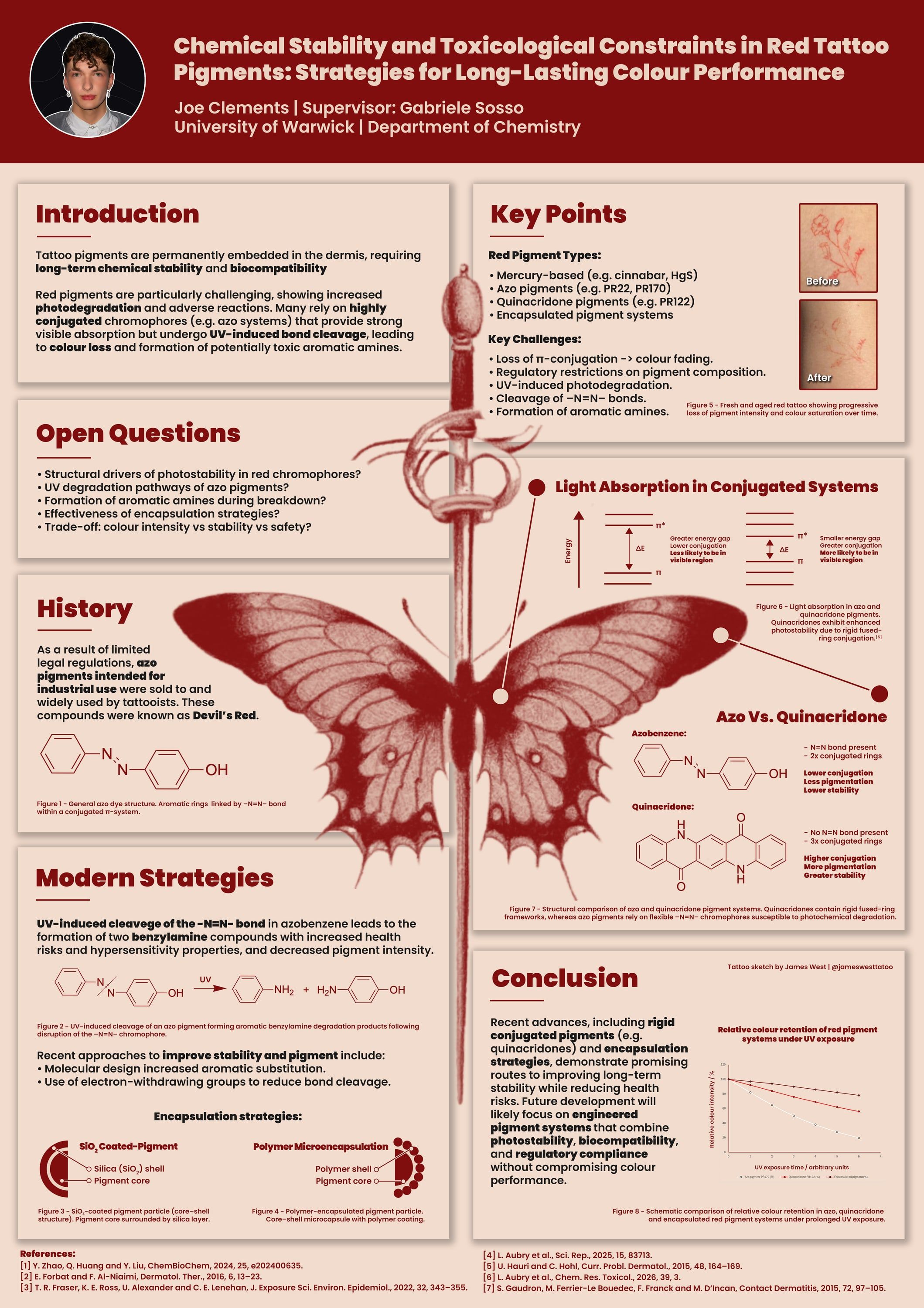
Chemical Stability and Toxicological Constraints in Red Tattoo Pigments: Strategies for Long-Lasting Colour Performance Joe Clements | Supervisor: Gabriele Sosso University of Warwick | Department of Chemistry
Introduction Tattoo pigments are permanently embedded in the dermis, requiring long-term chemical stability and biocompatibility. Red pigments are particularly challenging, showing increased photodegradation and adverse reactions. Many rely on highly conjugated chromophores (e.g. azo systems) that provide strong visible absorption but undergo UV-induced bond cleavage, leading to colour loss and formation of potentially toxic aromatic amines.
Open Questions • Structural drivers of photostability in red chromophores? • UV degradation pathways of azo pigments? • Formation of aromatic amines during breakdown? • Effectiveness of encapsulation strategies? • Trade-off: colour intensity vs stability vs safety?
History As a result of limited legal regulations, azo pigments intended for industrial use were sold to and widely used by tattooists. These compounds were known as Devil's Red. Figure 1: General azo dye structure. Aromatic rings linked by –N=N– bond within a conjugated π-system.
Modern Strategies UV-induced cleavage of the –N=N– bond in azobenzene leads to the formation of two benzylamine compounds with increased health risks and hypersensitivity properties, and decreased pigment intensity. Figure 2: UV-induced cleavage of an azo pigment forming aromatic benzylamine degradation products following disruption of the –N=N– chromophore. Recent approaches to improve stability and pigment include: • Molecular design increased aromatic substitution. • Use of electron-withdrawing groups to reduce bond cleavage. Encapsulation strategies: SiO₂ coated pigment: silica (SiO₂) shell around a pigment core. Figure 3: SiO₂-coated pigment particle (core–shell structure). Pigment core surrounded by silica layer. Polymer microencapsulation: polymer shell around a pigment core. Figure 4: Polymer-encapsulated pigment particle. Core–shell microcapsule with polymer coating.
Key Points Red pigment types: • Mercury-based (e.g. cinnabar, HgS) • Azo pigments (e.g. PR22, PR170) • Quinacridone pigments (e.g. PR122) • Encapsulated pigment systems Key challenges: • Loss of π-conjugation leading to colour fading. • Regulatory restrictions on pigment composition. • UV-induced photodegradation. • Cleavage of –N=N– bonds. • Formation of aromatic amines. Figure 5: Fresh and aged red tattoo showing progressive loss of pigment intensity and colour saturation over time.
Light Absorption in Conjugated Systems Greater energy gap, lower conjugation: less likely to be in the visible region. Smaller energy gap, greater conjugation: more likely to be in the visible region. Figure 6: Light absorption in azo and quinacridone pigments. Quinacridones exhibit enhanced photostability due to rigid fused-ring conjugation.
Azo vs Quinacridone Azobenzene: N=N bond present; 2x conjugated rings. Lower conjugation, less pigmentation, lower stability. Quinacridone: no N=N bond present; 3x conjugated rings. Higher conjugation, more pigmentation, greater stability. Figure 7: Structural comparison of azo and quinacridone pigment systems. Quinacridones contain rigid fused-ring frameworks, whereas azo pigments rely on flexible –N=N– chromophores susceptible to photochemical degradation.
Conclusion Recent advances, including rigid conjugated pigments (e.g. quinacridones) and encapsulation strategies, demonstrate promising routes to improving long-term stability while reducing health risks. Future development will likely focus on engineered pigment systems that combine photostability, biocompatibility, and regulatory compliance without compromising colour performance. Chart: relative colour retention of red pigment systems under UV exposure, comparing azo pigment PR170, quinacridone PR122 and an encapsulated pigment. Figure 8: Schematic comparison of relative colour retention in azo, quinacridone and encapsulated red pigment systems under prolonged UV exposure. Tattoo sketch by James West | @jameswesttatoo
References [1] Y. Zhao, Q. Huang and Y. Liu, ChemBioChem, 2024, 25, e202400635. [2] E. Forbat and F. Al-Niaimi, Dermatol. Ther., 2016, 6, 13–23. [3] T. R. Fraser, K. E. Ross, U. Alexander and C. E. Lenehan, J. Exposure Sci. Environ. Epidemiol., 2022, 32, 343–355. [4] L. Aubry et al., Sci. Rep., 2025, 15, 83713. [5] U. Hauri and C. Hohl, Curr. Probl. Dermatol., 2015, 48, 164–169. [6] L. Aubry et al., Chem. Res. Toxicol., 2026, 39, 3. [7] S. Gaudron, M. Ferrier-Le Bouedec, F. Franck and M. D'Incan, Contact Dermatitis, 2015, 72, 97–105.