Beyond the 'Typical Student'.
An exploratory research project on how belonging is understood, experienced and supported across UK higher education, and a challenge to the idea of the 'typical student'.
Overview
Belonging has become a familiar part of the conversation in higher education, and there’s strong evidence that it matters. But as the research went on, Kabirah Koroma and I kept coming back to one question: who are universities imagining when they talk about “the student”?
This exploratory project, funded by the Centre for Belonging in Education, looked at the gap between what we know about belonging and how that knowledge turns into practice. Its central conclusion is that universities don’t need another belonging initiative. They need to break down the idea of the “typical student” that can sit behind the way belonging is researched, measured and delivered.
How we did it
We started with a review of 26 publications, alongside sector reports, surveys and existing belonging projects, looking at what institutions already do well and where the gaps are. As the review developed, we deliberately widened it to experiences that approaches built around a “typical student” can overlook, including LGBTQIA+ students, care-experienced and estranged students, online learners, disabled and neurodivergent students, mature students, international students and commuters.
We then used the gaps in the literature to shape seven semi-structured interviews with experts working across higher education, student experience, inclusion and belonging. Rather than asking them to define belonging, we asked where research and practice diverge, which students and transition points are still overlooked and what institutions could do differently. The interviews were anonymised and analysed thematically alongside the wider research.
What we found
Three connected lenses came out of the analysis, and they shape both the article and the infographics.
- The student: students arrive with different identities, backgrounds, responsibilities and support networks, and these differences intersect. Belonging can’t be built around an imagined average.
- The journey: belonging moves. It’s affected well beyond Welcome Week, by setbacks, the move into second year, placements, coming back, postgraduate study and graduation.
- The institution: belonging is shaped by everyday teaching, relationships, systems and spaces. It needs to be everyone’s responsibility, not an isolated initiative.
We also found a lot that already works, from growing recognition that academic spaces can be belonging spaces to strong support for student partnership. The aim isn’t to discard that work but to make it more consistent and more responsive.
Turning it into something people would read
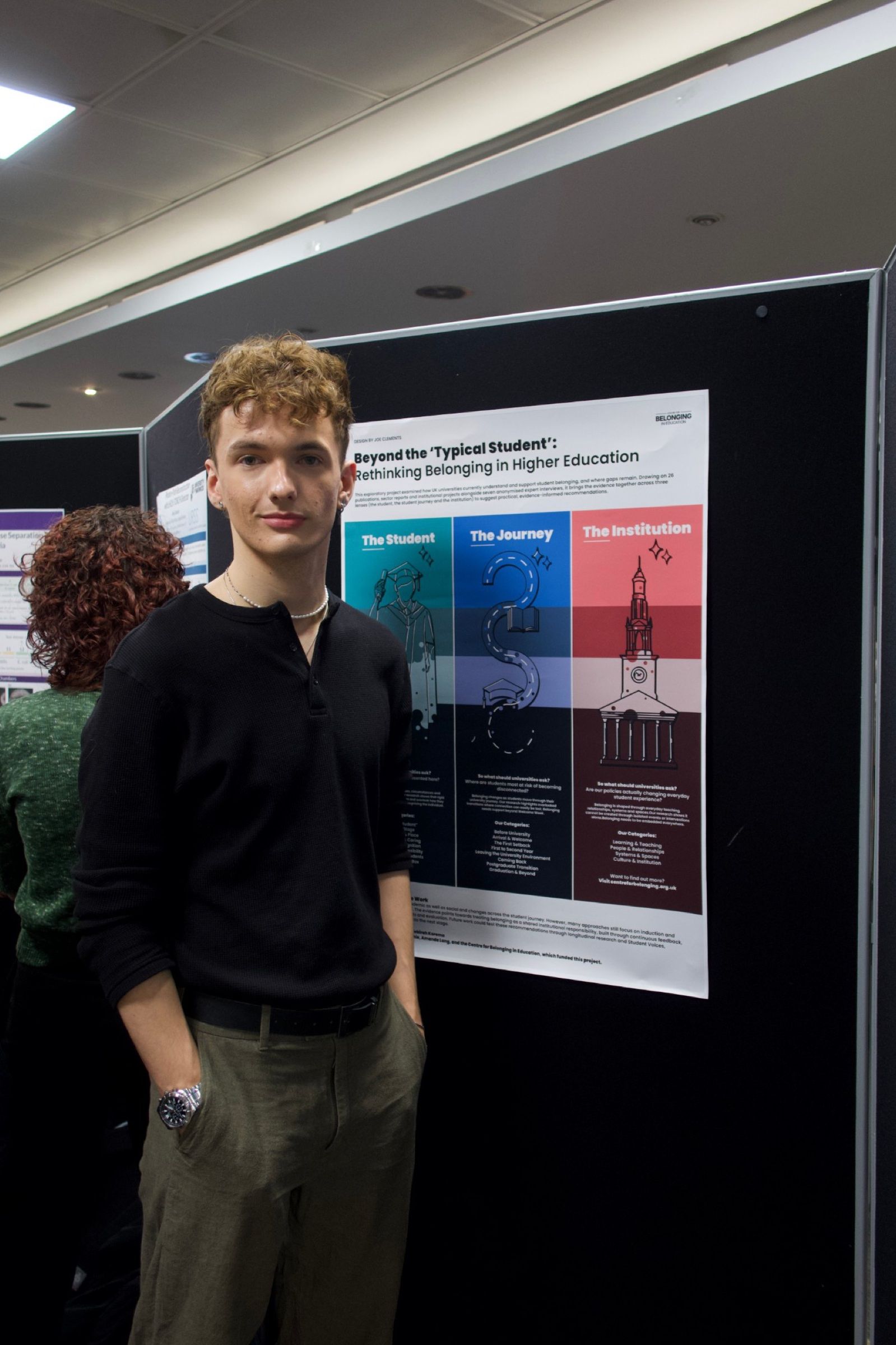
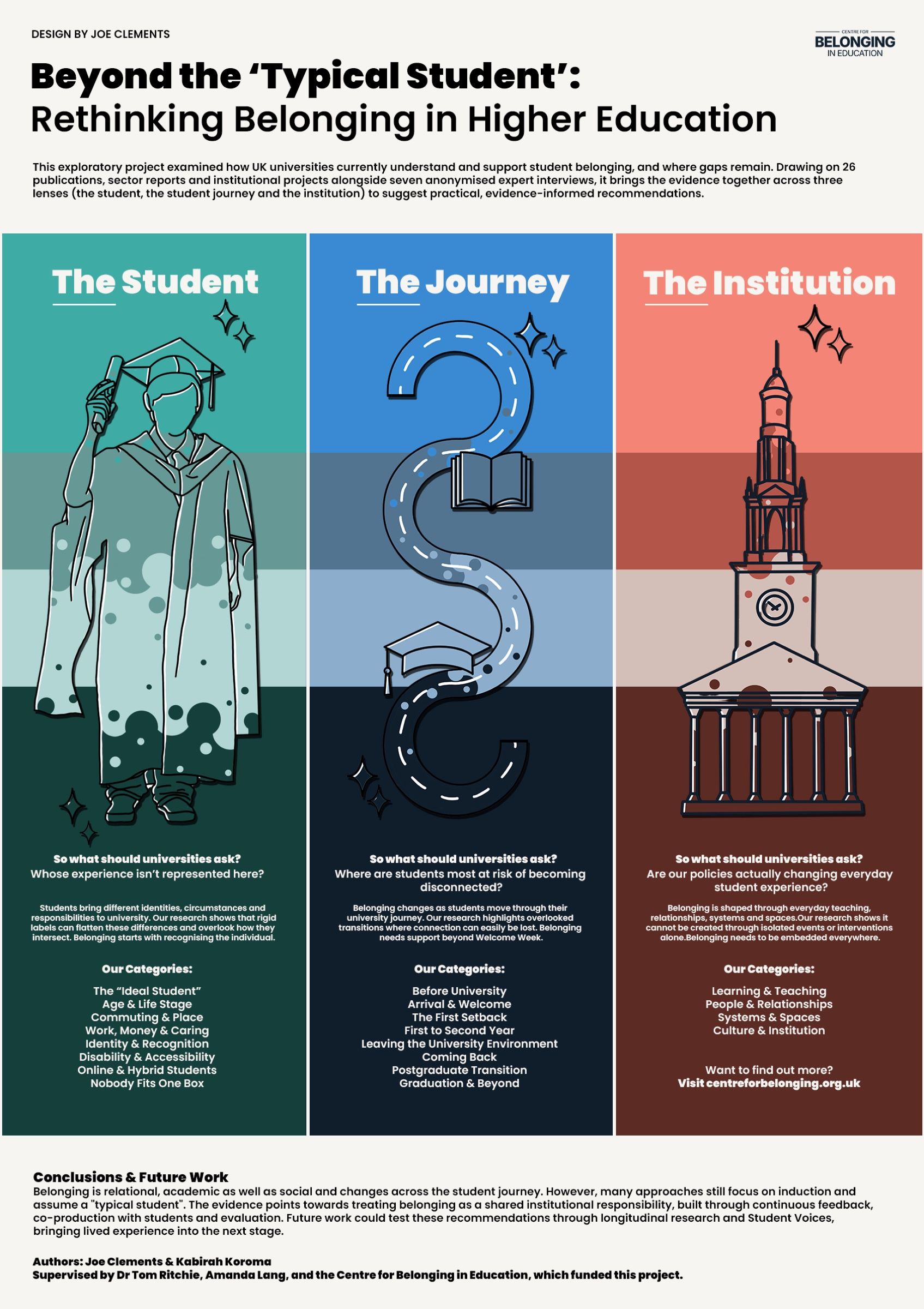
I designed an infographic for each lens and a poster that brings them together, so the findings could be understood at a glance and shared beyond an academic audience. The poster was shown at the URSS showcase in 2026. Each infographic asks one question universities can take away: whose experience isn’t represented here, where students are most at risk of becoming disconnected and whether policies are actually changing everyday student experience.
What’s next
The project doesn’t claim to be a final model of belonging. Student populations and contexts keep changing, so any useful framework has to keep listening and changing too. The findings are informing the Centre’s next stage of research and the development of a more responsive belonging framework, with Student Voices bringing lived experience into that work.
Read the text
Beyond the 'Typical Student': Rethinking Belonging in Higher Education
This exploratory project examined how UK universities currently understand and support student belonging, and where gaps remain. Drawing on 26 publications, sector reports and institutional projects alongside seven anonymised expert interviews, it brings the evidence together across three lenses (the student, the student journey and the institution) to suggest practical, evidence-informed recommendations.
The Student So what should universities ask? Whose experience isn't represented here? Students bring different identities, circumstances and responsibilities to university. Our research shows that rigid labels can flatten these differences and overlook how they intersect. Belonging starts with recognising the individual. Our categories: The "Ideal Student"; Age & Life Stage; Commuting & Place; Work, Money & Caring; Identity & Recognition; Disability & Accessibility; Online & Hybrid Students; Nobody Fits One Box.
The Journey So what should universities ask? Where are students most at risk of becoming disconnected? Belonging changes as students move through their university journey. Our research highlights overlooked transitions where connection can easily be lost. Belonging needs support beyond Welcome Week. Our categories: Before University; Arrival & Welcome; The First Setback; First to Second Year; Leaving the University Environment; Coming Back; Postgraduate Transition; Graduation & Beyond.
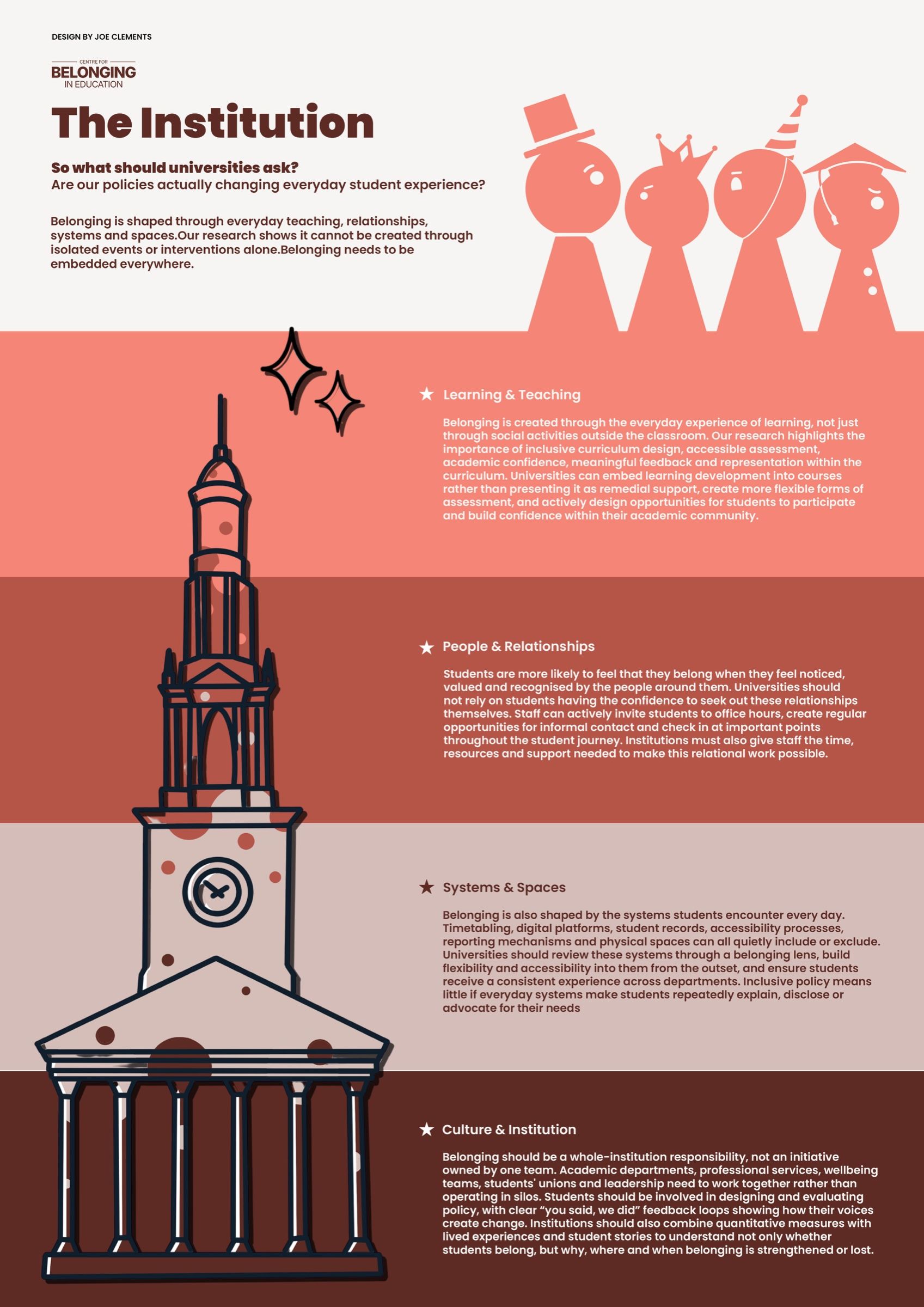
The Institution So what should universities ask? Are our policies actually changing everyday student experience? Belonging is shaped through everyday teaching, relationships, systems and spaces. Our research shows it cannot be created through isolated events or interventions alone. Belonging needs to be embedded everywhere. Our categories: Learning & Teaching; People & Relationships; Systems & Spaces; Culture & Institution. Want to find out more? Visit centreforbelonging.org.uk
Conclusions & Future Work Belonging is relational, academic as well as social and changes across the student journey. However, many approaches still focus on induction and assume a "typical student". The evidence points towards treating belonging as a shared institutional responsibility, built through continuous feedback, co-production with students and evaluation. Future work could test these recommendations through longitudinal research and Student Voices, bringing lived experience into the next stage.
Authors: Joe Clements & Kabirah Koroma Supervised by Dr Tom Ritchie, Amanda Lang and the Centre for Belonging in Education, which funded this project.
Read the text
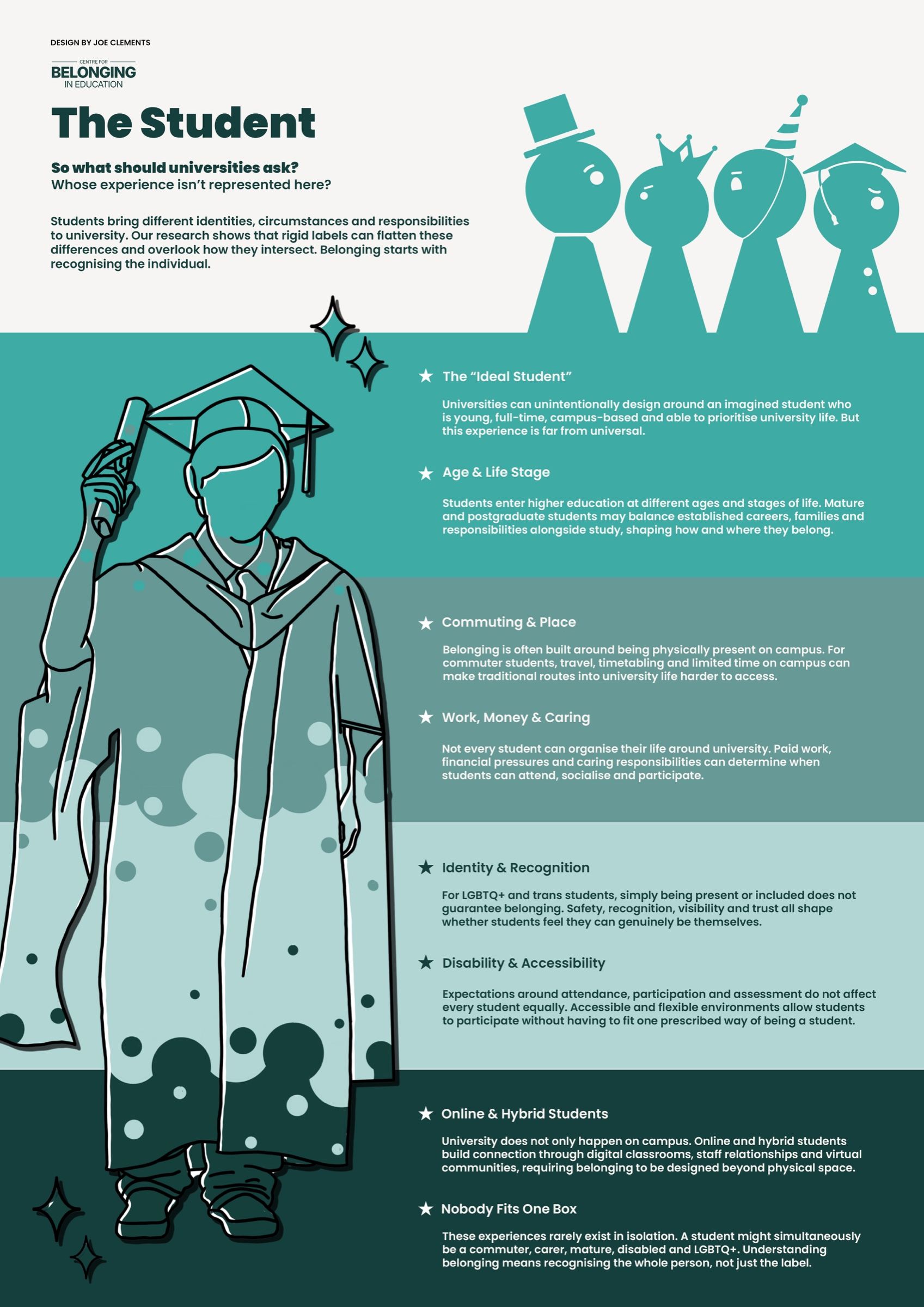
The Student
So what should universities ask? Whose experience isn't represented here?
Students bring different identities, circumstances and responsibilities to university. Our research shows that rigid labels can flatten these differences and overlook how they intersect. Belonging starts with recognising the individual.
The "Ideal Student" Universities can unintentionally design around an imagined student who is young, full-time, campus-based and able to prioritise university life. But this experience is far from universal.
Age & Life Stage Students enter higher education at different ages and stages of life. Mature and postgraduate students may balance established careers, families and responsibilities alongside study, shaping how and where they belong.
Commuting & Place Belonging is often built around being physically present on campus. For commuter students, travel, timetabling and limited time on campus can make traditional routes into university life harder to access.
Work, Money & Caring Not every student can organise their life around university. Paid work, financial pressures and caring responsibilities can determine when students can attend, socialise and participate.
Identity & Recognition For LGBTQ+ and trans students, simply being present or included does not guarantee belonging. Safety, recognition, visibility and trust all shape whether students feel they can genuinely be themselves.
Disability & Accessibility Expectations around attendance, participation and assessment do not affect every student equally. Accessible and flexible environments allow students to participate without having to fit one prescribed way of being a student.
Online & Hybrid Students University does not only happen on campus. Online and hybrid students build connection through digital classrooms, staff relationships and virtual communities, requiring belonging to be designed beyond physical space.
Nobody Fits One Box These experiences rarely exist in isolation. A student might simultaneously be a commuter, carer, mature, disabled and LGBTQ+. Understanding belonging means recognising the whole person, not just the label.
Read the text
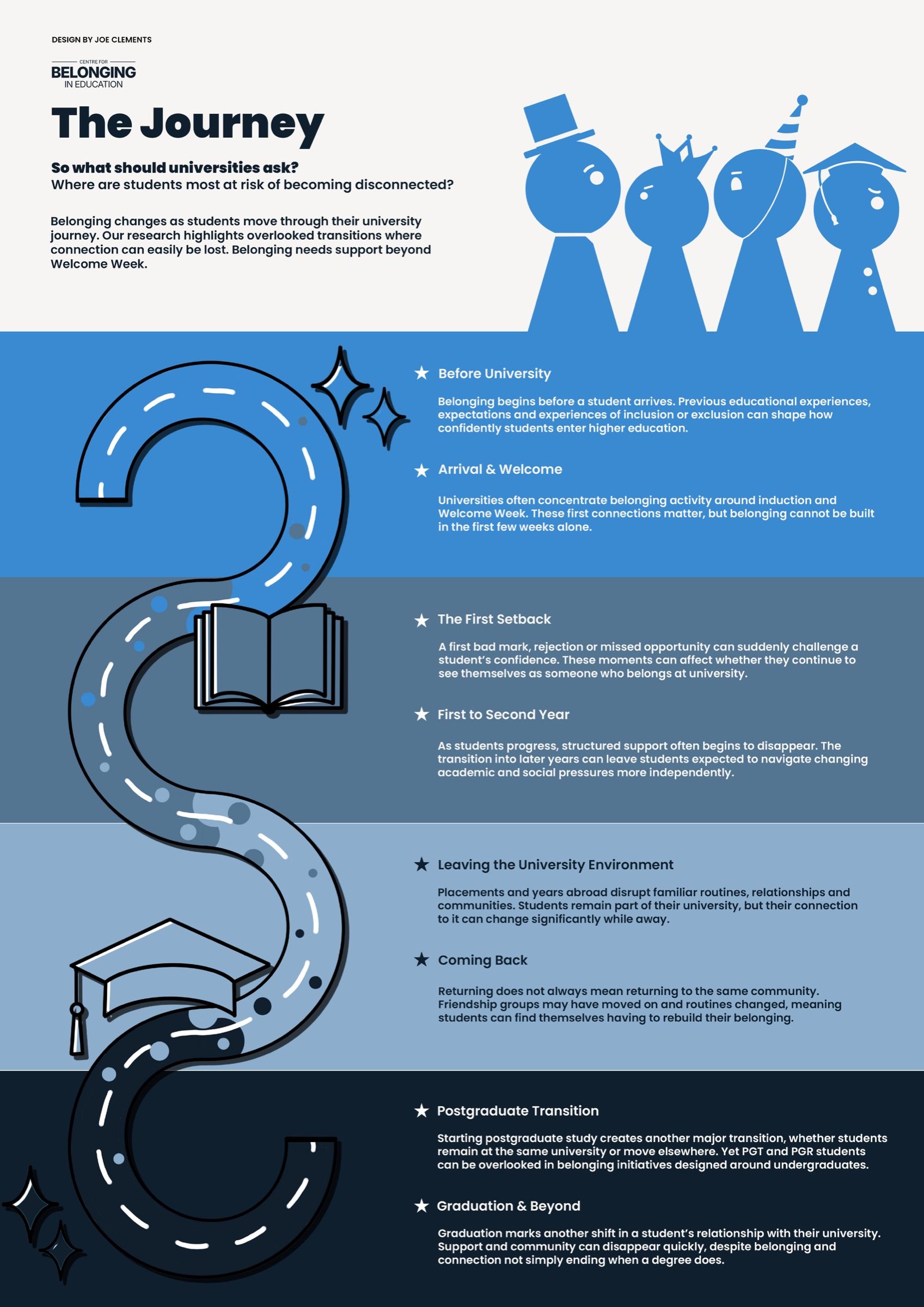
The Journey
So what should universities ask? Where are students most at risk of becoming disconnected?
Belonging changes as students move through their university journey. Our research highlights overlooked transitions where connection can easily be lost. Belonging needs support beyond Welcome Week.
Before University Belonging begins before a student arrives. Previous educational experiences, expectations and experiences of inclusion or exclusion can shape how confidently students enter higher education.
Arrival & Welcome Universities often concentrate belonging activity around induction and Welcome Week. These first connections matter, but belonging cannot be built in the first few weeks alone.
The First Setback A first bad mark, rejection or missed opportunity can suddenly challenge a student's confidence. These moments can affect whether they continue to see themselves as someone who belongs at university.
First to Second Year As students progress, structured support often begins to disappear. The transition into later years can leave students expected to navigate changing academic and social pressures more independently.
Leaving the University Environment Placements and years abroad disrupt familiar routines, relationships and communities. Students remain part of their university, but their connection to it can change significantly while away.
Coming Back Returning does not always mean returning to the same community. Friendship groups may have moved on and routines changed, meaning students can find themselves having to rebuild their belonging.
Postgraduate Transition Starting postgraduate study creates another major transition, whether students remain at the same university or move elsewhere. Yet PGT and PGR students can be overlooked in belonging initiatives designed around undergraduates.
Graduation & Beyond Graduation marks another shift in a student's relationship with their university. Support and community can disappear quickly, despite belonging and connection not simply ending when a degree does.
Read the text
The Institution
So what should universities ask? Are our policies actually changing everyday student experience?
Belonging is shaped through everyday teaching, relationships, systems and spaces. Our research shows it cannot be created through isolated events or interventions alone. Belonging needs to be embedded everywhere.
Learning & Teaching Belonging is created through the everyday experience of learning, not just through social activities outside the classroom. Our research highlights the importance of inclusive curriculum design, accessible assessment, academic confidence, meaningful feedback and representation within the curriculum. Universities can embed learning development into courses rather than presenting it as remedial support, create more flexible forms of assessment, and actively design opportunities for students to participate and build confidence within their academic community.
People & Relationships Students are more likely to feel that they belong when they feel noticed, valued and recognised by the people around them. Universities should not rely on students having the confidence to seek out these relationships themselves. Staff can actively invite students to office hours, create regular opportunities for informal contact and check in at important points throughout the student journey. Institutions must also give staff the time, resources and support needed to make this relational work possible.
Systems & Spaces Belonging is also shaped by the systems students encounter every day. Timetabling, digital platforms, student records, accessibility processes, reporting mechanisms and physical spaces can all quietly include or exclude. Universities should review these systems through a belonging lens, build flexibility and accessibility into them from the outset, and ensure students receive a consistent experience across departments. Inclusive policy means little if everyday systems make students repeatedly explain, disclose or advocate for their needs.
Culture & Institution Belonging should be a whole-institution responsibility, not an initiative owned by one team. Academic departments, professional services, wellbeing teams, students' unions and leadership need to work together rather than operating in silos. Students should be involved in designing and evaluating policy, with clear "you said, we did" feedback loops showing how their voices create change. Institutions should also combine quantitative measures with lived experiences and student stories to understand not only whether students belong, but why, where and when belonging is strengthened or lost.